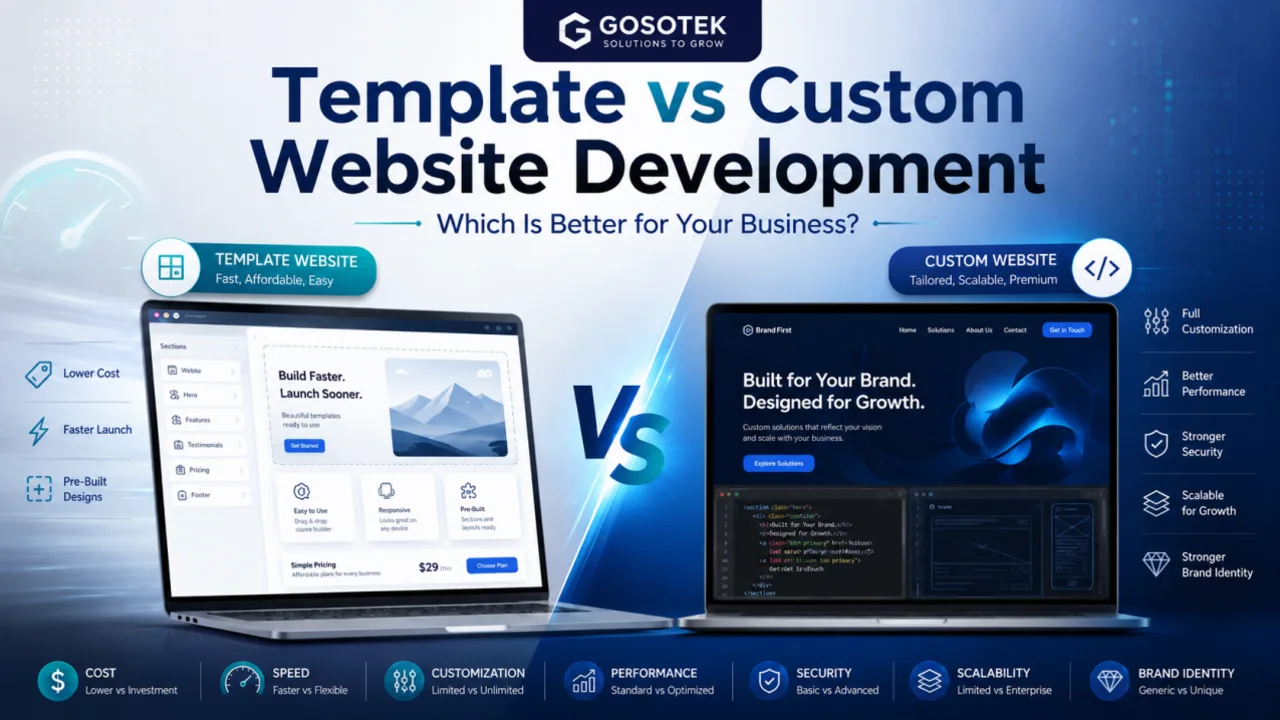
Choosing between a template and a custom-built website affects cost, launch time, performance, upgrades and brand identity. Templates suit standard requirements and faster launches; custom development suits unique functionality, integrations or flexibility.
Template vs Custom Website: Quick Comparison
| Factor | Template Website | Custom Website |
|---|---|---|
| Development cost | Lower initial cost | Higher initial investment |
| Launch time | Usually faster | Requires more planning |
| Customization | Limited by the theme or builder | Built around specific requirements |
| Performance | Depends on theme and plugins | Can be optimized for actual use |
| Scalability | Suitable for basic growth | Better for complex expansion |
| Brand identity | May resemble other websites | More distinctive and consistent |
| Maintenance | Relies on theme and plugin updates | Requires planned technical support |
When a Template Website Works Well
A template website uses a pre-designed structure from a CMS, e-commerce platform or website builder. Developers adjust its colours, content, images and available features.
This approach suits small business websites, portfolios, landing pages and simple online stores. It usually costs less and launches sooner.
The common mistake is choosing a template only because its demo looks attractive. The theme may contain unnecessary features, limited layouts or several plugin dependencies.
A consultancy needing service pages, a contact form and basic lead generation may not require a custom build. A carefully selected template can work efficiently.
When Custom Website Development Is Better
A custom website is planned around your business goals, users and technical requirements.
It is more suitable when you need dashboards, multiple user roles, advanced booking, custom pricing, automation, third-party integrations or a unique content structure.
Custom development also provides greater control over brand identity. Instead of fitting your business into an existing layout, the experience is designed around your positioning.
A B2B platform with separate access for customers, agents and administrators may quickly outgrow a template. Building the right structure early can prevent redevelopment.
Performance, Security and Scalability
Custom websites are not automatically faster or safer, and template websites are not automatically weak. Results depend on development quality, hosting, updates and maintenance.
Templates may slow down when heavy themes and unnecessary plugins are used. Custom websites allow more precise optimization, but poor code can create similar issues.
Both approaches require secure hosting, backups, access controls, software updates and monitoring.
Scalability is the clearest difference. Templates suit standard growth, while custom development offers greater control when traffic, integrations, workflows or user roles become more complex.
Common Mistakes to Avoid
Deciding only on the initial price.
Building custom functionality for a simple brochure website.
Selecting a template without checking plugin dependence.
Ignoring hosting, maintenance and upgrade costs.
Starting development without defining goals and required features.
Gosotek’s Perspective
At Gosotek, we do not treat templates and custom development as competing solutions. Both are useful when matched with the right requirement.
We assess the website’s purpose, users, integrations, budget, timeline and growth plan. Sometimes a customized template is the practical choice. In other cases, custom development avoids costly limitations later.
The best approach should solve today’s needs without restricting tomorrow’s growth.
FAQs
Is a custom website always better?
No. It is worthwhile only when your functionality, branding or growth requirements justify the investment.
Can a template website look professional?
Yes. Good design, suitable content and customization can produce a polished website.
Which option is easier to maintain?
Templates may be simpler initially, but themes and plugins create dependencies. Custom websites need structured technical support.
Can I move from a template to a custom website later?
Yes, although content, data and integrations may need migration or redevelopment.
How should I choose?
Compare your required features, budget, deadline, brand needs and expected growth.
Conclusion
Choose a template website when requirements are standard, the deadline is short and the budget is limited. Choose custom development when you need unique functionality, stronger differentiation or long-term scalability.