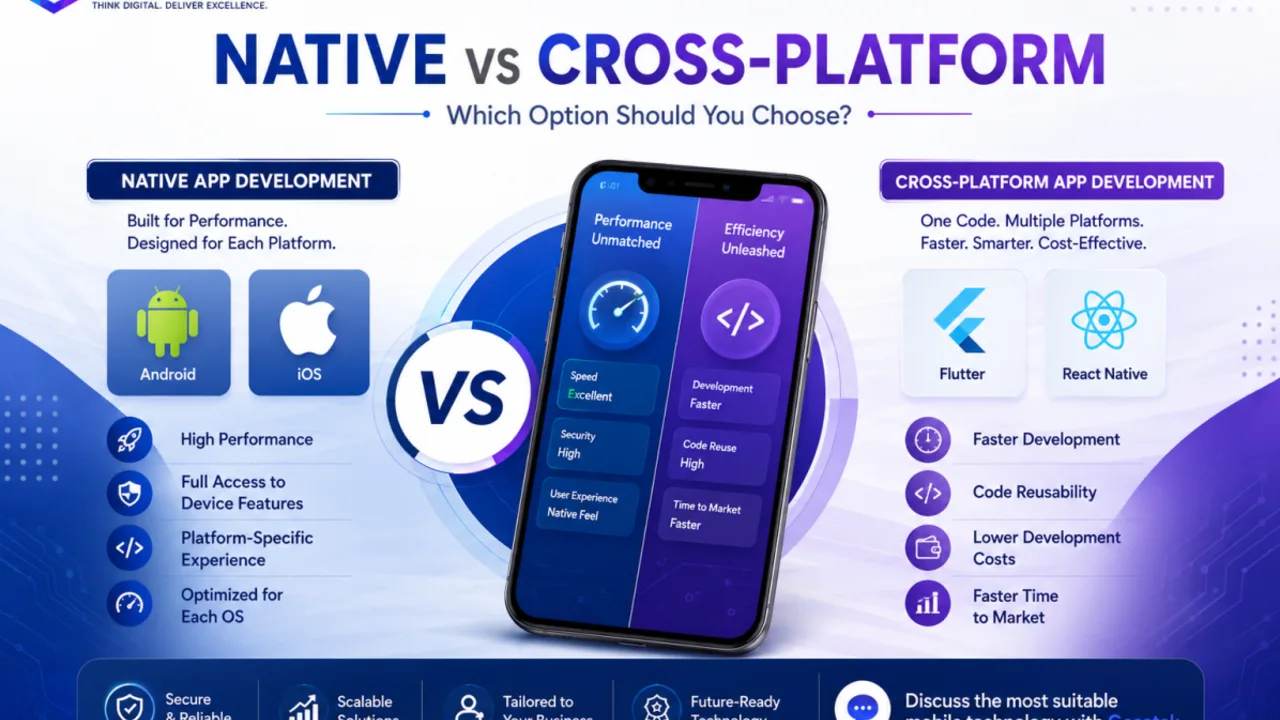
Choosing between native and cross-platform app development affects your budget, launch timeline, performance and long-term maintenance.
Native development creates separate apps for Android and iOS. Cross-platform development uses frameworks such as Flutter or React Native to share much of the code across both platforms. The right choice depends on what your app must achieve—not which framework is popular.
What Is Native App Development?
Native Android apps are commonly built with Kotlin and Android tools, while native iOS apps use Swift and Apple frameworks. Google recommends Jetpack Compose for modern native Android interfaces, while Apple provides SwiftUI for applications across Apple platforms.
Native development gives direct control over hardware, operating-system features and platform-specific design. It suits apps needing:
Advanced camera, Bluetooth, sensor or background processing
High-performance graphics or complex animations
Different Android and iOS experiences
Deep platform-specific integrations
The drawback is higher development effort. Supporting both platforms may require separate codebases, specialist developers and duplicated testing.
What Is Cross-Platform Development?
Cross-platform frameworks let one team build Android and iOS apps with a largely shared codebase.
Flutter creates natively compiled, multi-platform apps from one codebase. React Native uses JavaScript and React while rendering through native platform components and APIs.
This approach often suits e-commerce apps, booking systems, internal business tools, marketplaces and MVPs that must reach both platforms quickly.
Native vs Cross-Platform: Key Differences
| Factor | Native Development | Cross-Platform Development |
|---|---|---|
| Development cost | Usually higher for two platforms | Usually lower through code reuse |
| Performance | Maximum platform-level control | Strong for most business apps |
| Time to market | Longer for a dual-platform launch | Faster simultaneous launch |
| Code reuse | Limited | Significant |
| UI control | Precise on each platform | May need platform-specific adjustments |
| Maintenance | Two development tracks | More centralised |
| Scalability | Strong for complex products | Strong with sound architecture |
Flutter or React Native?
Choose Flutter when:
You want a consistent interface, custom animations or possible expansion to web and desktop. Flutter supports mobile, web, desktop and embedded platforms through a shared codebase.
Choose React Native when:
Your team already uses React or JavaScript, prefers native UI components, or needs to integrate with an existing native application. React Native also supports communication between cross-platform features and native modules.
Neither option automatically guarantees lower costs. Weak planning, unnecessary features and poor testing can remove the benefits of shared code.
Gosotek’s Practical Selection Approach
At Gosotek, we would not select a framework before understanding the product. A catalogue app and a real-time video-processing app need different decision criteria.
Before choosing, assess:
Required device features and integrations
Android-only, iOS-only or dual-platform launch
Expected users and future modules
Budget, deadline and maintenance plans
A common mistake is choosing native development for a simple MVP because it sounds more scalable. Another is choosing cross-platform only because it appears cheaper.
Long-term scalability also depends on backend architecture, testing, code quality, security and future feature planning.
Which Option Should You Choose?
Choose native development when your app requires maximum performance, advanced hardware access or distinctly different Android and iOS experiences.
Choose Flutter or React Native when you need faster delivery, code reuse and controlled development costs for a typical business application.
The best option supports your product roadmap for several years—not merely the fastest first release.
Frequently Asked Questions
Is cross-platform development suitable for large apps?
Yes, when the architecture, testing process and native integrations are planned correctly.
Is a native app always faster?
Native development offers greater platform control, but many standard business apps show little user-visible performance difference.
Can cross-platform apps access device features?
Yes. However, specialised hardware or operating-system features may still require native code.
Which costs less: Flutter or React Native?
The final cost depends on features, integrations, development expertise and maintenance requirements—not only the framework.
Can a cross-platform app move to native later?
Yes, but migration can be expensive. The initial technology decision should therefore consider the long-term roadmap.
Conclusion
Both native and cross-platform development can produce scalable, user-friendly mobile applications. The correct choice depends on performance needs, feature complexity, budget, release strategy and future expansion.