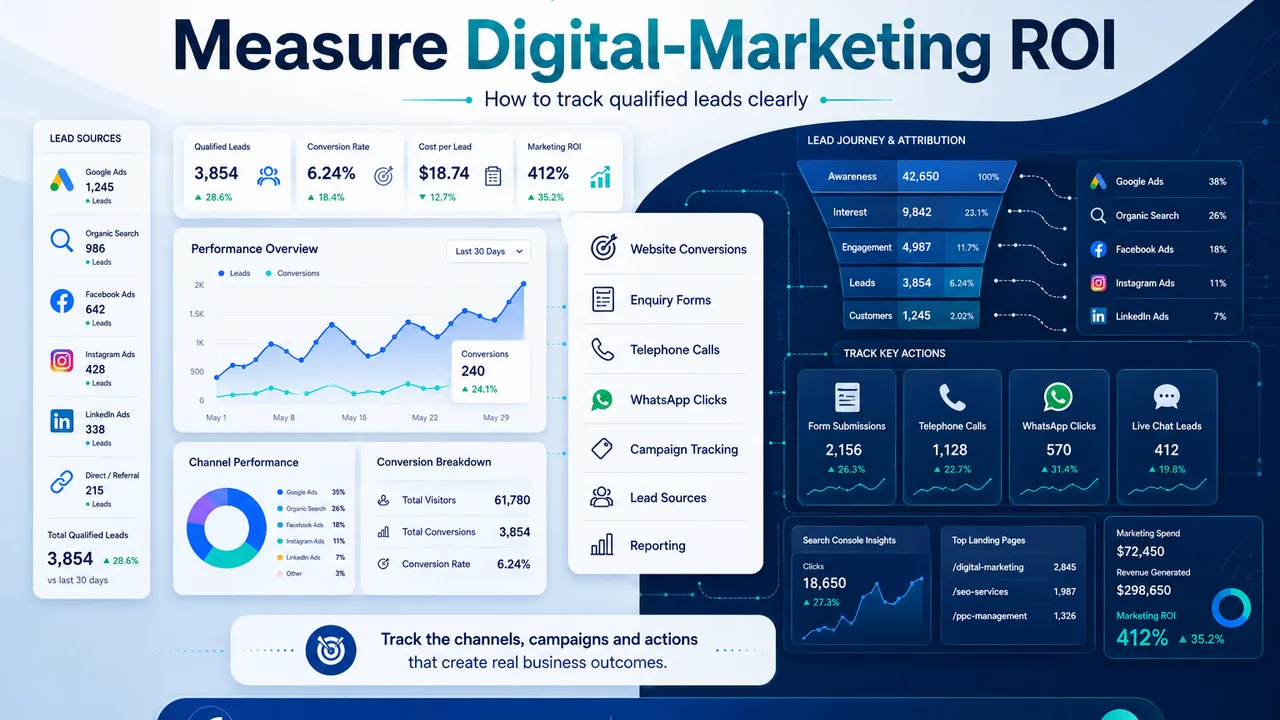
Digital-marketing reports often highlight clicks, impressions and website traffic. These numbers are useful, but they do not prove that marketing is generating valuable business.
A better measurement system connects each campaign to enquiries, qualified leads, sales and revenue. The objective is not simply to count activity. It is to understand which channels create commercial outcomes.
Define a Valuable Conversion
Start by listing the actions that matter to the business:
Enquiry-form submissions
Telephone calls
WhatsApp button clicks
Appointment bookings
Demo or quotation requests
Purchases or completed payments
Analytics tools can record common interactions such as form activity and outbound clicks, but businesses should still verify that events are being captured correctly and classify the most important actions as conversions or key events.
Track Every Lead Source
Use campaign parameters on links from Google Ads, social media, email, partner websites and QR codes. These parameters help analytics tools identify the source, medium and campaign connected with a website visit.
Create separate tracking links for different campaigns. Using one common URL everywhere makes it difficult to identify which activity influenced an enquiry.
Measure Calls and WhatsApp Clicks
Telephone leads are important for many Indian service businesses. Track clicks on mobile call buttons and, where appropriate, use call-conversion tools to measure calls generated after advertising interactions.
WhatsApp links usually lead visitors away from the website, so they can be measured as outbound-click events. Configure a specific event for the WhatsApp button rather than grouping it with every external link.
Remember that a click is not automatically a qualified lead. The sales team should record whether the person matched the service area, budget, requirement and purchase timeline.
Connect Marketing Data With Lead Status
A simple lead sheet or CRM should include:
| Field | Example |
|---|---|
| Lead source | Google Ads |
| Campaign | Jaipur website development |
| Enquiry type | |
| Lead quality | Qualified |
| Estimated value | ₹80,000 |
| Final status | Won |
Without lead-status updates, marketing teams may optimize campaigns for cheap enquiries that never become customers.
Use Search Console and Analytics Together
Search Console shows organic-search clicks, impressions, click-through rate, average position, queries and pages. It helps identify which topics create visibility and which pages attract search traffic.
Analytics shows what users do after arriving. Compare landing pages, channels, campaigns and conversion actions. Search Console explains search visibility; analytics explains website behaviour.
Calculate Marketing ROI
Use a consistent formula: Marketing ROI = (Revenue attributed to marketing − marketing cost) ÷ marketing cost × 100.
Include advertising spend, agency fees, content production, software and landing-page costs where relevant. Also track cost per qualified lead, lead-to-sale conversion rate, customer acquisition cost, revenue by campaign and sales cycle length.
A campaign producing ten qualified leads may be more valuable than one producing fifty irrelevant enquiries.
Common Reporting Mistakes
Counting every enquiry as equal
Reporting only website traffic
Ignoring telephone and WhatsApp leads
Using inconsistent campaign names
Failing to update lead status
Claiming revenue without a defined attribution method
The Gosotek Perspective
A useful dashboard should help a manager decide what to stop, improve or expand. It should separate visibility metrics from business metrics and clearly identify where tracking data is incomplete.
Frequently Asked Questions
What is a qualified lead?
A lead that reasonably matches the business’s service, location, budget, authority and buying timeline.
Is website traffic a marketing result?
Traffic is an indicator, not a final business result. It must be connected with meaningful customer actions.
Can WhatsApp enquiries be tracked?
Website clicks can be tracked through analytics events, while lead quality and sales outcomes should be recorded in a CRM or lead sheet.
Why do analytics and advertising reports differ?
Platforms may use different attribution rules, time windows, identity methods and conversion definitions.
Conclusion
Reliable ROI measurement requires accurate events, consistent campaign tracking and disciplined lead-status updates. Your reporting dashboard should connect marketing activity with qualified opportunities and revenue—not simply clicks and impressions.