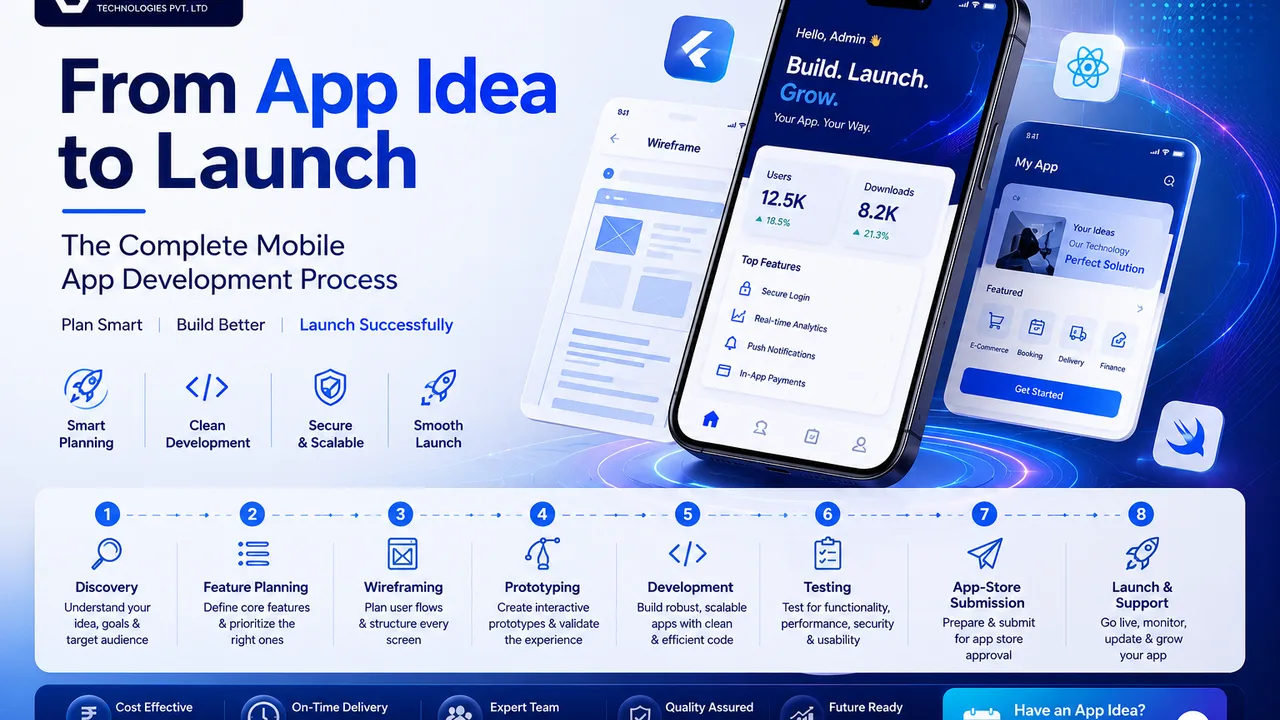
A mobile app usually begins with a simple thought: “What if customers could do this from their phones?”
Turning that idea into a reliable Android or iOS app requires more than writing code. The development process must define the problem, prioritize features, validate the user experience, test real-world scenarios and prepare the product for launch.
Here is how the complete mobile app development process works—and what businesses should prepare at every stage.
1. Discovery: Clarifying the App Idea
Discovery establishes why the app should exist and who will use it.
The development team studies:
The business problem the app will solve
Target users and their expectations
Competitor applications
Revenue or operational goals
Platform requirements
Budget and timeline expectations
For example, a wholesale ordering app may need customer-specific pricing, product catalogues, repeat orders and payment tracking. A fitness app may focus more on subscriptions, progress tracking and notifications.
A common mistake is beginning development with only a general idea. Without clear objectives, features keep changing and the project becomes difficult to estimate.
2. Feature Planning: Defining the First Version
Feature planning converts the idea into a structured product scope.
Features are normally divided into three groups:
| Priority | Purpose | Example |
|---|---|---|
| Essential | Required for the app to function | Login, search, checkout |
| Important | Improves usability | Notifications, saved items |
| Future | Can be added after launch | Loyalty points, advanced reports |
The first release should solve the main user problem without becoming overloaded. This is often called a Minimum Viable Product, or MVP.
At Gosotek, we prefer planning the app in phases. This helps businesses launch a practical first version while keeping future scalability in mind.
3. Wireframing: Planning Every Screen
A wireframe is a basic visual structure of the app. It shows where buttons, menus, forms and content will appear.
Wireframes help answer important questions early:
Can users complete important actions easily?
Are too many steps required?
Is navigation clear?
Are any screens missing?
Changing a wireframe is faster and less expensive than modifying a completed application.
4. Prototyping: Testing the Experience Before Coding
A prototype is a clickable representation of the app. It allows stakeholders to move between screens and experience the proposed user journey.
For example, an e-commerce prototype may demonstrate how a customer searches for a product, adds it to the cart and completes an order.
Prototyping reduces misunderstandings between the client, designer and development team. It also gives businesses an opportunity to collect early feedback before development begins.
5. Development: Building the Application
Once the design and requirements are approved, developers build the app.
This stage may include:
Android, iOS or cross-platform development
Backend and database development
APIs and third-party integrations
Admin panel development
Payment gateway integration
Security and user-access controls
Development usually happens in planned milestones. Clients should review working builds regularly instead of waiting until the entire application is complete.
6. Testing: Finding Problems Before Users Do
Testing checks whether the app works correctly across different devices, screen sizes and usage conditions.
The team reviews functionality, performance, usability, security and compatibility. Testers also examine situations such as weak internet connectivity, failed payments, incorrect form entries and interrupted sessions.
A common mistake is testing only the ideal user journey. Real users may skip steps, enter unexpected information or use older devices.
7. App-Store Submission and Approval
After testing, the app is prepared for submission to the relevant app stores.
This normally involves:
App name and description
Screenshots and icons
Privacy-related information
Category selection
Release build preparation
Store-review compliance
Submission should be treated as a planned project stage, not a last-minute task. Missing information or compliance issues can delay approval.
8. Launch and Post-Launch Support
Launching the app is the beginning of real-world learning.
After release, the team should monitor crashes, performance, user feedback and feature usage. Post-launch support may include bug fixes, operating-system compatibility updates, security maintenance and future feature development.
The strongest apps improve gradually based on actual user behaviour rather than assumptions made before launch.
Gosotek’s Perspective
Successful mobile app development depends on decisions made before coding begins. Clear discovery, phased feature planning and early design validation can prevent unnecessary rework.
Gosotek helps businesses move from an initial app concept to a structured, scalable and launch-ready product while maintaining visibility throughout the development process.
Frequently Asked Questions
- How long does mobile app development take?
The timeline depends on the number of features, platforms, integrations and approval cycles. A focused first version is generally faster to deliver than a feature-heavy application.
- Should I launch on Android and iOS together?
It depends on your target audience, budget and business priorities. Some businesses begin with one platform, while others use cross-platform development to support both.
- Do I need an admin panel?
An admin panel is useful when the business needs to manage users, content, orders, reports or notifications without changing the app code.
- Can new features be added after launch?
Yes. The app should be planned with a scalable architecture so future modules can be added without rebuilding the complete product.
- Who handles app maintenance after launch?
Maintenance may be handled by the original development team or another technical partner. Responsibilities should be clearly defined before the project begins.
Conclusion
Moving from an app idea to launch requires structured planning, user-focused design, reliable development and continuous improvement. Businesses that validate requirements early are better positioned to control scope, budget and launch quality.
Schedule a mobile-app planning consultation with Gosotek to discuss your idea, essential features and the most practical development roadmap.